|
|
||
|
HOME | THE FUTURE TODAY | BUSINESS
NEED | BOOK YOUR SEAT TODAY | COURSE REGISTRATION
| CONTACT |
|
|
|
Industry
4.0 and Industry 5.0 are here!! |
|
|
|
What is Industry 4.0?
Also known as the Fourth Industrial Revolution, it is defined as the integration of intelligent digital technologies into manufacturing and industrial processes. It encompasses a set of technologies that include industrial IoT networks, AI, Big Data, robotics, and automation. What
is Industry 5.0? It is also known as the Fifth Industrial Revolution, a new and emerging phase of industrialisation that sees humans working alongside advanced technology and A.I. -powered robots to enhance workplace processes. Why
is this important to you? You are going to have to compete with generative artificial intelligence and advanced robotics. Generative Artificial intelligence (GAI) refers to computer systems capable of performing complex tasks that historically only a human could do, such as reasoning, making decisions, or solving problems. To compete with this, and remain in control, you will need a smart mind. What
is ChatGPT or Grok, and why does it matter? ChatGPT and Grok are natural language processing tools driven by AI technology that allows you to have human-like conversations and much more with these chatbots. These language models can answer questions and assist you with tasks, such as composing emails, essays, and code. "ChatGPT and Grok are scary good. We are not far from dangerously strong AI," said Elon Musk. As of August 2025, ChatGPT had 700 million active users while Grok had 30.1 million users. It is strongly recommended that you read “What ChatGPT 5.0 AI says about the evolving nature of the relationship between Artificial Intelligence, robots and humans,” a conversation between Tony Stone and AI’s ChatGPT 5.0 is a MUST READ. In fact, it's for your own benefit and that of your children. What ChatGPT says about the future Elon Musk is concerned about his children’s future careers — especially if his kids have to compete with artificial general intelligence for their dream jobs. “How do we actually find fulfilment, how do we find meaning in life, if AGI can do your job better than you can?” Office and administrative roles could be at risk. So could content-creating jobs, from designers to software engineers — though new opportunities could involve training and maintaining quality control for the AI systems that create such content. For jobs that require uniquely human skills, AI may simply become a tool that makes work easier. Those could range from physically demanding roles like construction to communication-centric jobs like therapists. “Jobs that emphasize interpersonal skills are much harder to be replaced by an AI.” This is what ChatGPT said when it was asked: “For humans to remain employable, and compete with AI, what do they need? To remain employable and effectively compete with AI, humans can focus on developing and enhancing certain skills and qualities that are uniquely human and not easily replicated by AI. Here are some areas to consider: 1.
LESSON 1: Understanding your own
psychology 2.
LESSON 2: Emotional intelligence &
interpersonal skills 3.
LESSON 3: Adaptability and continuous
learning 4.
LESSON 4: Critical thinking and
proactive problem solving 5.
LESSON 5: Creativity and innovation 6.
LESSON 6: Complex problem-solving and
strategy development 7.
LESSON 7: Ethical and social
understanding 8.
LESSON 8: The psychology of
human/GAI/robot interaction 9.
LESSON 9: Motivation Each lesson is preceded by an assessment tool. You then complete the lesson, compare what you have learned by doing a gap analysis against the assessment results followed by a practical training program to develop your skills and close the gaps. By focusing on these areas, individuals can position themselves to work alongside GAI systems, leveraging their unique strengths and capabilities while benefiting from the efficiency and assistance that AI technology offers. It's important to adapt and continuously upgrade skills to meet the changing demands of the evolving job market. A human's trust in an AI agent or robot is an important factor in human-AI/GAI collaboration, dictating whether the human should follow or override the AI's or GAI’s input. Various factors impact a person's trust in an AI system, including its accuracy and reliability. Your reality is that AI and GAI will be adopted. You will need superior soft skills to survive in this radically changing world. Your competitive advantage is your mind. You need to develop it. Just a word of caution. Always test what a AI App tells you. There is one particular AI App that initially responds to sociopolitical issues with politically correct responses. Don’t be afraid to challenge the AI App if you know what it is saying is not the absolute truth. ChatGPT is a good AI App to use to test other AI Apps. Also, even though we have GAI, some of these Apps lack the intuitive capabilities of the human brain. The ability to connect seemingly unrelated but related dots does not exist in some of these Apps. So, in a nutshell, a number of AI Apps are constrained by the lack of genuine common sense and emotional intelligence. Their reliance on historical data, which can cause algorithmic bias, and have a tendency to "hallucinate" incorrect information. Additionally, AI cannot easily transfer knowledge across entirely different contexts without retraining. Yes, AI and GAI is really useful, and is continuously improving, but it does not beat the capabilities of the human brain. Not yet anyway. So,
what is a smart mind? Smart is often used to describe a person who has improved their mind through study and learning, while intelligence is used to describe a person who was born with or has developed mental sharpness and/or is naturally good at learning new things. Intelligence can be seen as a stronger version of the word smart. Agility is
the ability to adapt and
respond to change. And, how to manage
your own psychology, especially in dealing with GAI and robots! |
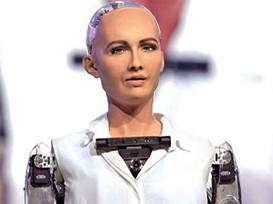
The State of robotics today!! Sophia (robot) Sophia is a social humanoid robot
developed by the Hong Kong-based company Hanson Robotics.
Image
Credit: Hanson Robotics Sophia is known for its human-like
appearance and behaviour. She or it, imitates human gestures and facial
expressions and is able to engage in conversations about predefined topics. Hanson has said that he designed Sophia
to be a suitable companion for the elderly at nursing homes, to help crowds
at large events or parks, or to serve in customer service, therapy, and
educational applications, and that he hopes that the robot can ultimately
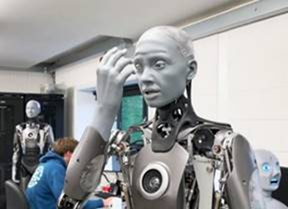
interact with other humans sufficiently to gain social skills. Ameca (robot) Ameca is a humanoid robot developed by
UK-based Engineered Arts
Image
Credit: Engineered Arts Ameca possesses impressive
capabilities. This advanced robot can detect sounds, understand and
communicate in multiple languages, and express emotions through realistic
facial movements. It utilizes embedded microphones,
binocular eye mounted cameras, a chest camera and facial recognition software
to interact with the public. Interactions can be governed by either GPT-3 or
human telepresence. Ameca also features articulated motorized arms, fingers,
neck and facial features. Jia Jia (robot) China’s University of Science and
Technology humanoid robot can turn on the charm.
Image
Credit: US&T She, or it, can hold a conversation and
make specific facial expressions when asked, and her creator believes the
eerily life-like robot heralds a future of cyborg labour in China. Liberate Your Mind We can help you!! The time for YOU to adapt to change |
|

© Copyright Tony Stone 2024